 Errors on vintage football cards are common, presumably because the card companies intended the cards for kids, and they did not worry much about quality control. The errors range from incorrect player positions and statistics to reversed images and cards that picture the wrong player.
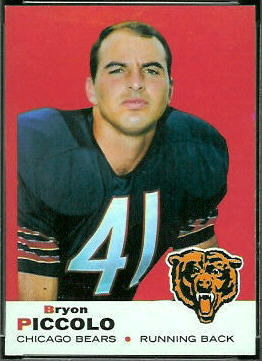
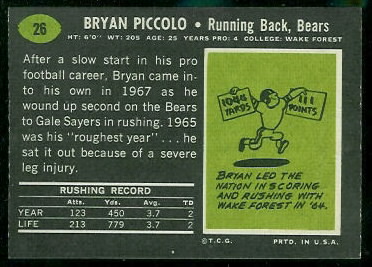
The most common error on vintage cards is probably misspelling of the player’s name. Pictured here is one example, Brian Piccolo’s 1969 Topps rookie card, which has his name misspelled Bryon on the front and Bryan on the back. Some players’ names were especially problematic: Sonny Jurgensen‘s name is misspelled on at least two cards, and so is Woodley Lewis‘s. Philadelphia Gum misspelled Herb Adderley’s name four years in a row, and Topps also misspelled it once. (How about Bob Hoernschemeyer, you ask? Well, guess what, Bowman got that one right every time!)
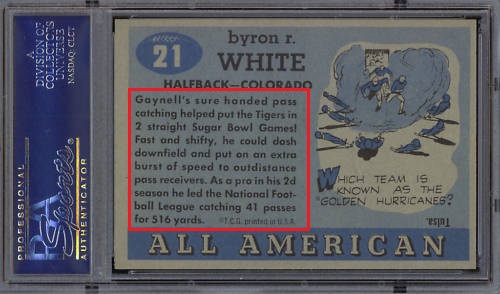
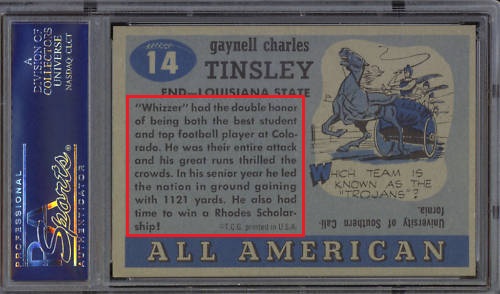
People sometimes ask me if error cards are valuable. The answer: usually not. Most errors were not corrected in production, so the error cards are no scarcer than the other cards in the set. (Price guides refer to these as uncorrected errors, abbreviated UER.) If a card company did correct an error in production, one version or the other–the error or the corrected card–can be much scarcer than the other cards in the set, and hence more valuable. Two examples come to mind: First, in the 1955 Topps All-American set, some of Byron White‘s cards were printed with Gaynell Tinsley‘s bio on the back, and some of Tinsley’s were printed with White’s. Topps corrected these errors after production began, and the incorrect versions are scarcer and more valuable than the corrected ones. 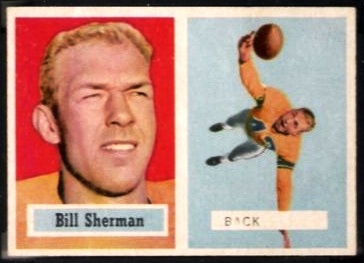 Second, in the 1957 Topps set, some copies of Will Sherman‘s card have white space where “RAMS” was supposed to go. Topps also corrected this error in production, and the “No Rams” version is scarcer and more valuable than the corrected version.
In regard to pricing, then, the error and corrected versions of a card are really just considered variations of the card. When a card has two variations, some collectors will desire both, and the scarcer one is generally worth more. It’s the same with errors and corrected cards.
Occasionally people send me scans of what they think are error cards, but what they actually have are cards with printing or processing problems: off-centering, double images, print marks, etc. These production flaws are not considered errors, and in most cases they hurt the value of the card. If a production flaw is particularly bad–say the card is miscut so badly that it includes part of the next card–a collector might pay a bit for the novelty, but usually the card will be worth far less than a card without the flaw.
Also, now and then someone will list a card on eBay that has been mislabeled by a grading company, claiming that it is a valuable error. It’s not. At least one grading company makes these so-called “mechanical errors” frequently, and the errors are just a nuisance to get corrected.
As I wrote a while back, the Advanced Search page in the Vintage Football Card Gallery supports searches for error cards. I have most of the major errors identified in the Gallery, and I am gradually adding the minor ones.