February 11th, 2014 |
Published in
error cards
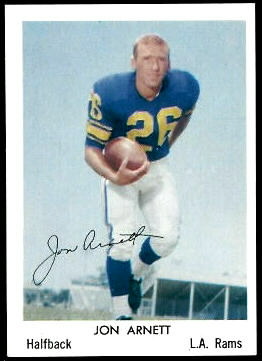
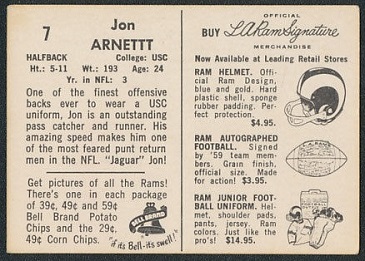
This might be the worst spelling error I have seen on a card, but it is not marked in the major price guides: on the back of Jon Arnett’s 1959 Bell Brand Rams card, his last name is misspelled “Arnettt,” with three t’s!
You can see all of the error cards in the Vintage Football Card Gallery here.
January 18th, 2014 |
Published in
error cards, Where They Are Now
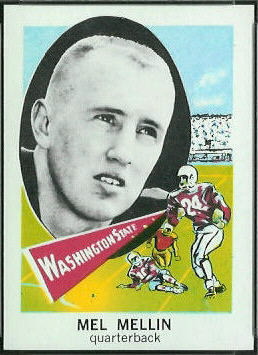 Error card collectors, here is another error card that is not marked in the price guides: on Mel Melin’s 1961 Nu-Card card, his last name is misspelled “Mellin.” Thanks to Philip, a visitor to my web sites, for pointing that out.
After starring at Washington State, Melin went on to play four seasons for the CFL‘s BC Lions. He appeared on at least one football card with BC, a 1963 Post Cereal CFL card. I don’t yet have the 1963 Post CFL set in the Vintage Football Card Gallery, but you can probably see the Melin card on eBay.
For more on Mr. Melin, check out “Where Are They Now: Mel Melin” on the Washington State University web site. To see more errors on old football cards, see the error card search page of the Vintage Football Card Gallery.
October 19th, 2013 |
Published in
error cards
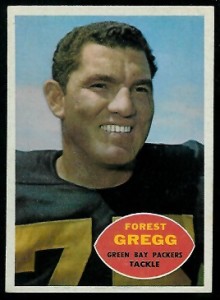
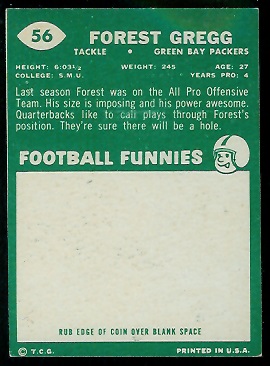
Last night, while talking on the phone, I was looking at a 1960 Topps Forrest Gregg football card that happened to be on my desk. Hmm, I thought, I don’t think I ever noticed that “Forrest” is missing an “r” on this card. So I checked my Gallery to see if I had previously marked it as an error. Nope. Then I checked my Beckett catalog to see if it was marked in there. Nope again. Then I checked a few more online checklists that I know of. Nope, nope, nope. Surely someone has noticed the error before–it’s a rookie card of a Hall of Famer, after all–but for some reason it hasn’t made it into the hobby publications.
So, at long last, I documented the error in my Gallery. Below are some pictures; you can see the misspelling once on the front and three times on the back.
To see all of the error cards in the Vintage Football Card Gallery, click here. For my previous blog articles about error cards–including others that don’t appear in the publications–click here.
May 9th, 2013 |
Published in
error cards
Yesterday I was looking at some 1964 Philadelphia football cards, and I happened to read the cartoon on the back of Lamar McHan’s card. The cartoon says that McHan won the Heisman Trophy. Hmm, I thought, that doesn’t sound right. So I checked my Heisman Trophy candidates page, and sure enough, the highest McHan finished in Heisman voting was ninth. Ninth is great, of course, but it isn’t first.
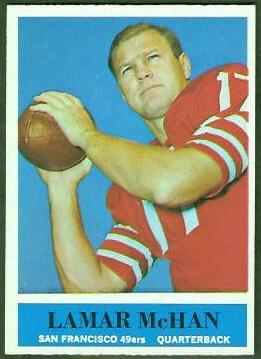
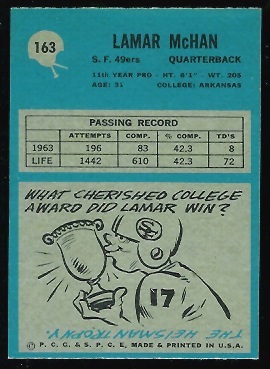
This is at least the second whopper I have seen in a cartoon on the back of a card. Homer Jones’s 1968 Topps football card says that “Homer defeated the Russians in the 1960 Olympics,” but that isn’t true, either. For a list of football players who did win Olympic medals, see my page of Olympic athletes on vintage football cards
May 5th, 2013 |
Published in
error cards, New in the Gallery
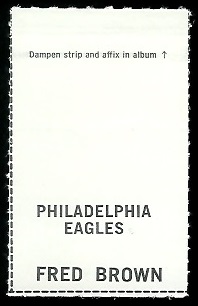
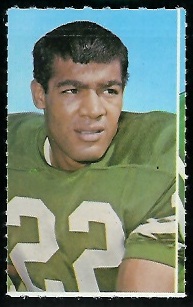 Yesterday I noticed that the player pictured on Fred Brown’s 1969 Glendale Stamp is actually Timmy Brown. Timmy Brown played for the Eagles until 1967, then played one season for the Baltimore Colts, then went on to a long acting career. Unfortunately, this is the only Fred Brown card or stamp I know of, so I don’t think his picture ever made it onto a card.
For many other cards and stamps that picture the wrong player, see the Mistaken Identities page of the Vintage Football Card Gallery.
April 10th, 2013 |
Published in
CFL Cards, error cards, Football Card Trivia
Here’s a trivia question for you: what legendary NFL running back appeared on the 1964 Topps CFL Saskatchewan Roughriders team card? Here is a picture of the card. The player is in the middle row, fourth from the left, wearing number 32.
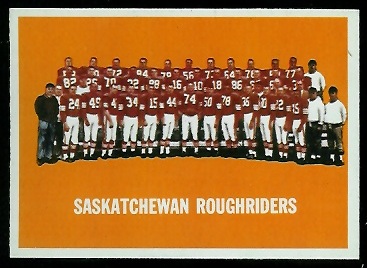
Give up? The answer is Jim Brown. What, you say, Jim Brown never played in the CFL? Well, it’s a trick question, because the team pictured on the card is not the 1964 Saskatchewan Roughriders. It is actually the 1959 Cleveland Browns. I learned this bit of trivia earlier this week from a post on a Roughriders forum.
But that’s not the extent of the error. Topps routinely used the same team photos for years at a time, and all of the Roughrider team cards in the 1961-1963 Topps CFL sets have the same mistake. Ironically, though Topps used the 1959 Browns photo on several CFL cards, this photo never appeared on an NFL card. Topps used a picture of the 1958 Browns team on all of its Browns team cards from 1959 to 1963.
For many more football cards that picture the wrong players, see the Mistaken Identities page of the Vintage Football Card Gallery.
April 2nd, 2013 |
Published in
Brothers, error cards, New in the Gallery
You learn something every week. 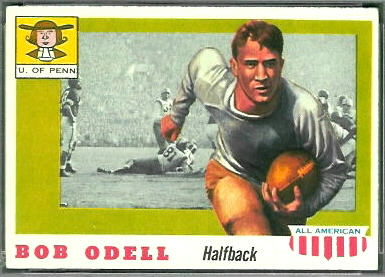 This week I learned from a post in the Collectors Universe forums that the player pictured on Bob Odell’s 1955 Topps All-American card is not Bob Odell. The impostor is Howard Odell, Bob’s older brother, who played at the University of Pittsburgh. For details–and to see many more cards that picture the wrong player–see the Mistaken Identities page of the Vintage Football Card Gallery.
March 23rd, 2013 |
Published in
error cards, Player Deaths
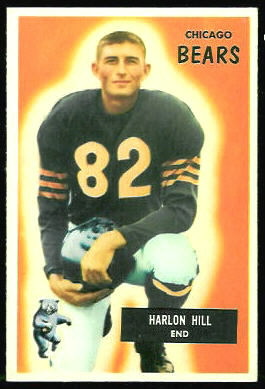
Harlon Hill, a receiver from 1954 to 1962 for the Chicago Bears, Detroit Lions, and Pittsburgh Steelers, passed away on March 21. Hill won the Newspaper Enterprise Association NFL MVP Award in 1955, and he is still the Bears’ second-leading all-time receiver. (Johnny Morris is first.) See whnt.com for a nice video tribute to Hill.
Hill played college football at Florence State Teachers College, now named the University of North Alabama. His quarterback for two seasons was George Lindsey, who became famous as Goober Pyle on the Andy Griffith Show. In 1986, the trophy for the Division II College Football Player of the Year was named after Hill.
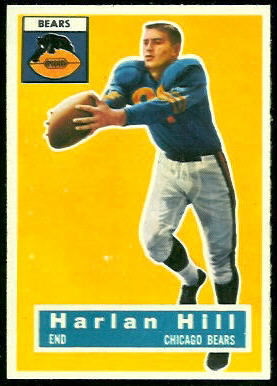
The cards pictured here are Hill’s rookie card, a 1955 Bowman, and his 1956 Topps card. (The 1956 card is an uncorrected error card: Topps misspelled his first name “Harlan.”) He appeared on at least seven more football cards, as well.
December 24th, 2012 |
Published in
error cards
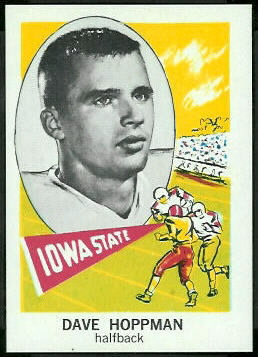 Error card collectors, here’s another error that isn’t marked in any of my price guides: Dave Hoppmann’s last name is missing an “n” on his 1961 Nu-Card card. I noticed the misspelling last week, when adding Hoppmann’s 1964 Topps CFL card to the Vintage Football Card Gallery.
For more undocumented error cards, see my previous articles on the subject. You can also search the Gallery for all of the error cards I know about. If you know of others, drop me a line.
October 11th, 2012 |
Published in
error cards, Player Deaths
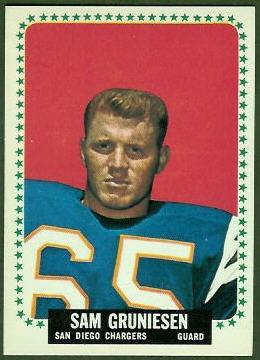 Sam Gruneisen, an offensive lineman from 1962 to 1973 for the San Diego Chargers and Houston Oilers, passed away on September 28. There is a picture of Gruneisen and a summary of his career on the Chargers web site. Gruneisen played in two AFL championship games with the Chargers, in 1964 and 1965, both losses to the Bills. At Villanova, Gruneisen was a tight end, linebacker, and kicker. He was elected to the Villanova Wall of Fame in 2000.
Pictured here is Gruneisen’s rookie card, a 1964 Topps. His name, unfortunately, is misspelled “Gruniesen” on the card. He also appeared on a 1966 Topps card–with his name spelled correctly–and on a 1969 Glendale stamp.
