July 9th, 2010 |
Published in
Sites I Like
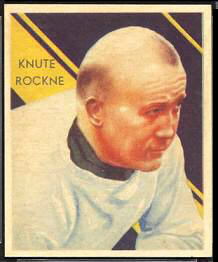 If you’re a Knute Rockne or Notre Dame fan, check out The Unofficial Homepage of Knute Rockne. It’s a tribute site assembled by Rockne’s cousin’s grandson, Birger Rokne, from Rockne’s hometown, Voss, Norway. I found Rockne’s association with Studebaker interesting–did you know that Studebaker produced a model called the Rockne? Cousin Birger has a restored one, and his site includes a photo or two.
The card shown here is Rockne’s 1935 National Chicle football card. It is the only card in the set that does not picture an NFL player. You can see Rockne’s other cards in the Vintage Football Card Gallery.
June 4th, 2010 |
Published in
Football Card Trivia
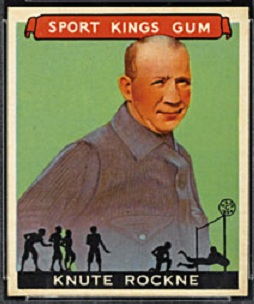 I started to write an article today about coaches on football cards, but then I realized that a lot of coaches appeared on football cards–too many to cover in one article. So I thought I’d break the subject into blog-sized pieces. This is the first.
Knute Rockne was the first coach to appear on a football card–or at least he’s the first I can think of. Pictured here is Rockne’s rookie card, from the 1933 Goudey Sport Kings multi-sport set. This is one of three football cards in the set, the others being Red Grange and Jim Thorpe. (The Virtual Card Collection web site shows all of the cards in the Sport Kings set.)
Until today, when I visited his official web site, I hadn’t realized that Rockne died in 1931, two years before his Sport Kings card was issued. He was only 43 when he was killed in a plane crash in Kansas, on his way to Los Angeles to assist with “The Spirit of Notre Dame,” a movie about–what else?–Notre Dame football. According to his Wikipedia page, “Rockne was…shrewd enough to recognize that intercollegiate sports had a show-business aspect. Thus he worked hard promoting Notre Dame football so as to make it financially successful.” His IMDB page shows that he worked on a number of short films released in 1931.
Rockne was also the second coach to appear on a football card, this one in the 1935 National Chicle set. His is definitely the odd card in this set, since the rest of the National Chicle cards show NFL players of the day. The image on Rockne’s National Chicle card also appeared on his 1955 Topps All-American card.
October 29th, 2009 |
Published in
New in the Gallery
Yesterday I added 1935 National Chicle cards to the Vintage Football Card Gallery. What a beautiful set! My favorite cards are the Pittsburgh Pirates, in their bumblebee uniforms. (The Pirates became the Steelers in 1939.)
For more about the set, see N is for National Chicle in my ABCs of Vintage Football Cards series.
July 31st, 2009 |
Published in
ABCs of Vintage Football Cards
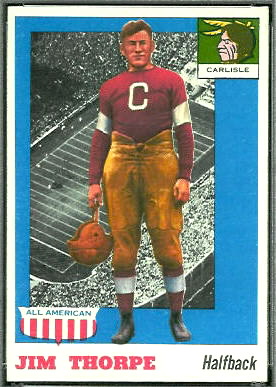 The 1955 Topps All-American set, 100 cards picturing college All-Americans through 1955, is probably the most popular vintage football card set. The key to its popularity is its player selection: it includes seventeen hall-of-famers, including six rookie cards; eleven Heisman trophy winners, including five rookie cards; Notre Dame legends Knute Rockne and the Four Horsemen; and even a U.S. Supreme Court Justice, Byron “Whizzer” White. It is also an attractive set, with a color picture of the player in the foreground and a black-and-white action picture in the background. The PSA Set Registry provides evidence of its popularity: at the time of this writing, collectors had registered 85 sets of All-Americans, far more than any other vintage set.
Prior to 1955, Topps had printed two other sets of cards of college players, 1950 Felt Backs and 1951 Magic cards, but those sets were limited to current players of the time, and they are not as attractive as the 1955 set. The 1950 Felt Backs are downright homely, but the set does include the rookie cards of Joe Paterno, Darrell Royal, and a couple of pro football hall-of-famers. The 1951 Topps Magic cards are more attractive, but the set holds only one significant rookie card: Heisman winner Vic Janowicz. In 1955, Topps played catch-up, including stars from decades earlier who had never appeared on cards before. The result: lots of rookie cards of famous players.
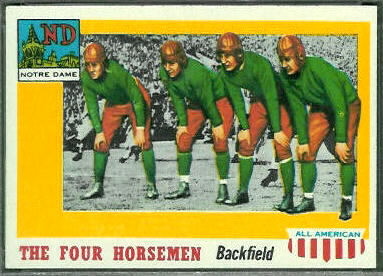 The 1955 All-American set began a run of annual Topps football sets that continues to this day. Topps dominated the football card market until 1989, when Score and ProSet introduced superior products. From 1968 to 1988, Topps had practically no competition in the market, and it showed: most of the cards they printed in the 1970’s and 1980’s were dull and nondescript compared to their early offerings.
A page by Mark Sullivan, a reference librarian at the Boston College Law School, provides other interesting facts about the 1955 Topps All-Americans: detailed descriptions of the cards, errors, and players who went on to fame outside of football. Check out that page, as well.


