May 9th, 2013 |
Published in
error cards
Yesterday I was looking at some 1964 Philadelphia football cards, and I happened to read the cartoon on the back of Lamar McHan’s card. The cartoon says that McHan won the Heisman Trophy. Hmm, I thought, that doesn’t sound right. So I checked my Heisman Trophy candidates page, and sure enough, the highest McHan finished in Heisman voting was ninth. Ninth is great, of course, but it isn’t first.
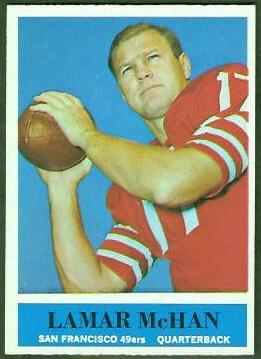
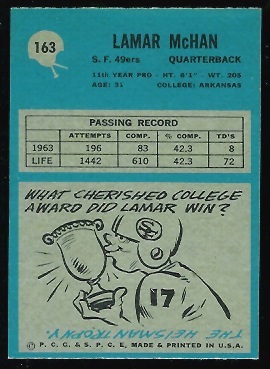
This is at least the second whopper I have seen in a cartoon on the back of a card. Homer Jones’s 1968 Topps football card says that “Homer defeated the Russians in the 1960 Olympics,” but that isn’t true, either. For a list of football players who did win Olympic medals, see my page of Olympic athletes on vintage football cards
February 10th, 2013 |
Published in
Milestone Birthdays
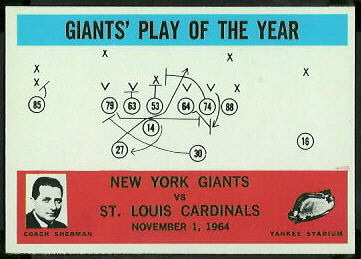 Allie Sherman, former NFL player and head coach, is celebrating his 90th birthday today. Sherman played from 1943 to 1947 for the Philadelphia Eagles, and he was the head coach of the New York Giants from 1961 to 1968. Sherman led the Giants to the league championship game in each of this first three seasons, and he was named NFL Coach of the Year in 1961 and 1962. He was inducted into the National Jewish Sports Hall of Fame in 1995. According to oldestlivingprofootball.com, Sherman is the 68th oldest living pro football player.
As far as I know, Sherman never appeared on a football card of his own. There is a small photo of him, however, on the 1964 Philadelphia and 1965 Philadelphia Giants Play of the Year cards. The 1965 card is pictured here.
Happy birthday, Mr. Sherman!
January 16th, 2013 |
Published in
Football Card Oddities
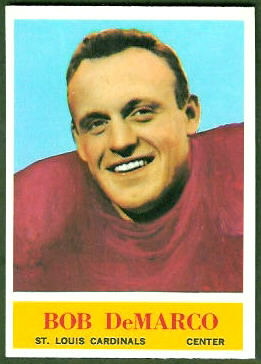 Whenever I see a copy of Bob DeMarco’s 1964 Philadelphia football card, I am puzzled. The image on the card was obviously airbrushed, but I don’t know why the card company would have airbrushed it. DeMarco had been with the Cardinals since his rookie season, 1961, so they wouldn’t have needed to change him out of another NFL team’s colors.
One possibility is that the photo was from DeMarco’s college days (he played at Dayton), and the card company wanted to cover his college jersey. (For an example of that, see John Brockington’s 1972 Topps cards.) That seems unlikely, though, since 1964 was DeMarco’s fourth year out of college, and they should have had a photo of him in a Cardinals uniform by then.
Another possibility is that DeMarco had been wearing a white Cardinals jersey for his photo, like the one on his 1966 card, but Philadelphia wanted all of the Cardinals in the set to be wearing red. The problem with that theory is that there are other players in the set whose jerseys don’t match the rest of their team, and their images haven’t been airbrushed. Tommy McDonald, for example, played for the Cowboys in 1964, but he is pictured still in Eagles green, not Cowboys blue.
At least one other image in the 1964 Philadelphia set appears to have been airbrushed, also, though not as badly: on Dick Schafrath’s card, it looks like Schafrath’s jersey was painted on. I can’t explain that one, either, unless it was to hide the neck roll he is shown wearing on his later Philadelphia cards.
Anyone else have a theory to explain the airbrushing?
January 3rd, 2013 |
Published in
Player Deaths
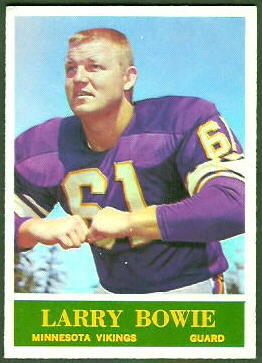
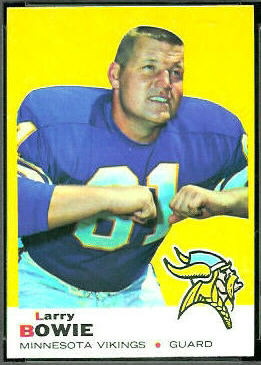
Larry Bowie, a guard for the Minnesota Vikings from 1962 to 1968, passed away on December 31. His obituary appeared in the Minneapolis/St. Paul Star Tribune. Bowie played college football at Purdue.
Bowie appeared on two regular issue football cards, the 1964 Philadelphia and 1969 Topps cards pictured here. He also appeared on a 1969 Topps mini-card.
June 17th, 2012 |
Published in
Fathers and Sons
As I have mentioned in other articles, I have been gradually adding fun facts for the cards in the Vintage Football Card Gallery. In May I identified the players whose brothers also played pro football (see my blog article Teammate Brothers), and this month I marked the players whose fathers or sons also played professionally. I used the Pro Football Hall of Fame’s list as a reference.
Many of the players on the Hall of Fame’s list never appeared on cards, and some of them appeared on newer cards that I don’t yet have in the Gallery. I did find five pairs of fathers and sons who both appear in the Gallery, though. In honor of Father’s Day, here they are:
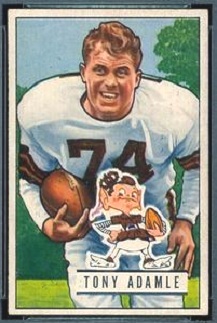
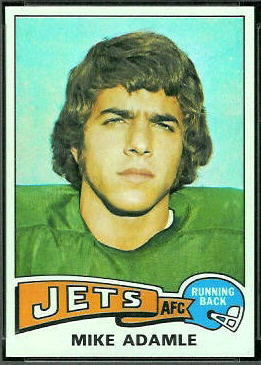
Tony Adamle played six seasons for the Cleveland Browns in the AAFC and NFL; his son Mike played six seasons for the Chiefs, Jets, and Bears. Tony is pictured here on his 1951 Bowman card, and Mike on his 1975 Topps card.
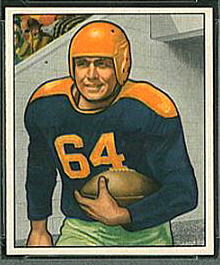
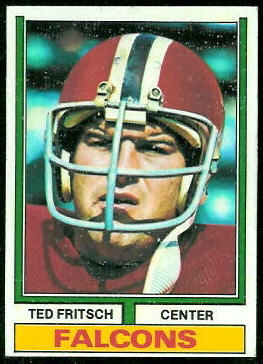
Ted Fritsch Sr., a member of the Green Bay Packers Hall of Fame, played from 1942 to 1950 for the Packers. Ted Fritsch Jr. played from 1972 to 1979 for the Falcons and Redskins. Ted Sr. appears here on his 1950 Bowman card; Ted Jr. is shown on his 1974 Topps card.
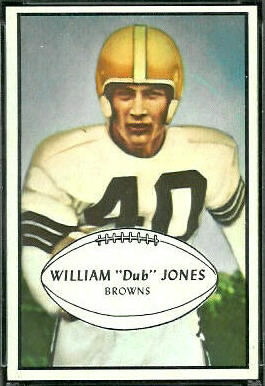
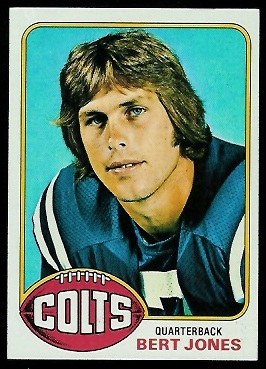
Dub Jones played for the Miami Seahawks, Brooklyn Dodgers, and Cleveland Browns in the AAFC, and he remained with the Browns when they joined the NFL in 1950. He is shown here on his 1953 Bowman card. Bert Jones, Dub’s son, was a quarterback for ten seasons with the Baltimore Colts and Los Angeles Rams. His 1976 Topps card is shown here.
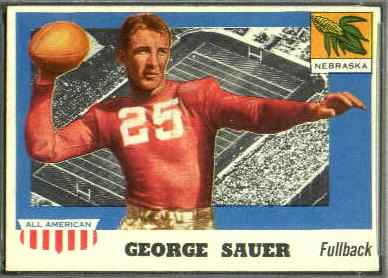
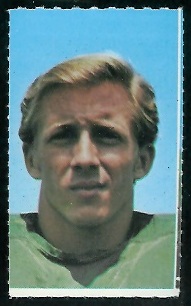
George Sauer Sr. played from 1933 to 1935 for the Green Bay Packers; he is shown here on his 1955 Topps All-American card. George Jr. played from 1966 to 1970 for the New York Jets; he is shown on a 1969 Glendale stamp.
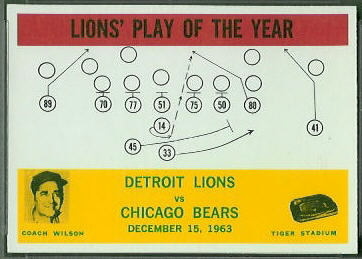
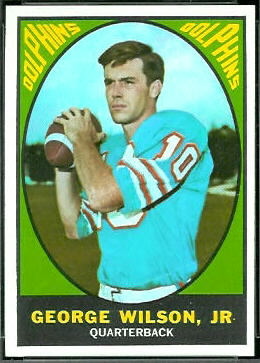
Finally, George Wilson Sr. played for the Chicago Bears for ten seasons, and he was head coach of the Detroit Lions and Miami Dolphins for thirteen. Wilson never appeared on a card of his own, but there is a small image of him on the 1964 Philadelphia Lions’ Play card shown here. Wilson’s son, George Jr., played for his father for one season at Miami. His 1967 Topps card is shown here.
Tags:
1950 Bowman,
1951 Bowman,
1953 Bowman,
1955 Topps All-American,
1964 Philadelphia,
1967 Topps,
1969 Glendale Stamps,
1974 Topps,
1975 Topps,
1976 Topps,
Baltimore Colts,
Bert Jones,
Cleveland Browns,
Detroit Lions,
Dub Jones,
George Sauer Jr.,
George Sauer Sr.,
George Wilson Jr.,
George Wilson Sr.,
Green Bay Packers,
Miami Dolphins,
Mike Adamle,
New York Jets,
St. Louis Cardinals,
Ted Fritsch Jr.,
Ted Fritsch Sr.,
Tony Adamle
May 24th, 2012 |
Published in
Player Deaths
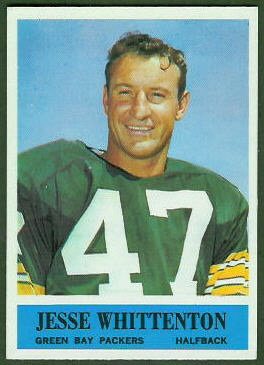 Jesse Whittenton, a defensive back from 1956 to 1964 for the Los Angeles Rams and Green Bay Packers, passed away on May 22. There is a story about Whittenton on the Milwaukee Journal Sentinal web site. Whittenton made the Pro Bowl twice, in 1961 and 1963, and he was a member of the Packers’ 1961 and 1962 NFL Championship teams. He was inducted into the Packers Hall of Fame in 1976.
Because the Lombardi-era Packers had so many other stars, Whittenton appeared on only one regular issue football card, the 1964 Philadelphia card pictured here. It was issued in his last season in the league. He also appeared on a 1961 Lake to Lake Packers card, a 1962 Post Cereal card, and a 1964 Wheaties stamp.
October 22nd, 2011 |
Published in
New in the Gallery
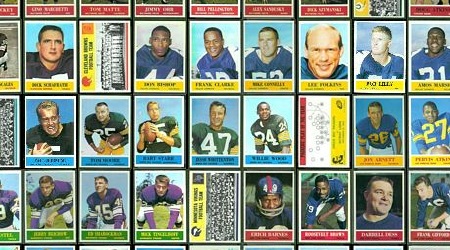
Yesterday I added a virtual uncut sheet of 1964 Philadelphia football cards to the Vintage Football Card Gallery. I modeled the virtual sheet after a real one that is for sale in an upcoming auction. Thanks to Steve of the thecowboysguide.com for pointing out the auction.
Whereas 1965, 1966, and 1967 Philadelphia sheets appear to have had the same card numbering scheme, the 1964 Philadelphia sheet is numbered differently. On the 1964 sheet, groups of five to ten teammates appear on consecutive cards in the same row. I suspect that this caused a lot of teammates to appear together in packs, and that’s why Philadelphia changed their numbering scheme in 1965 to one that appeared more random.
(Click on the image to see the full virtual sheet.)
September 23rd, 2011 |
Published in
Player Deaths
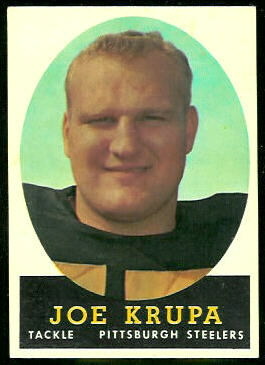
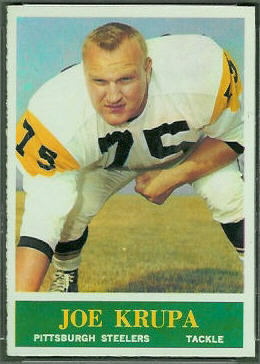
Joe Krupa, a defensive tackle for the Pittsburgh Steelers from 1956 to 1964, passed away on September 13. The Chicago Sun-Times web site has a report. Krupa was a Pro Bowler for the Steelers in 1963.
The cards pictured here are Krupa’s rookie card, a 1958 Topps, and his 1964 Philadelphia card. He also appeared on a 1959 Topps card, and on a number of minor issues. You can see all of Joe Krupa’s football cards in the Vintage Football Card Gallery.
July 7th, 2011 |
Published in
Player Deaths
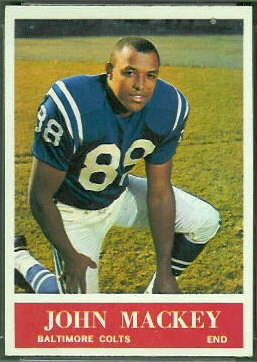
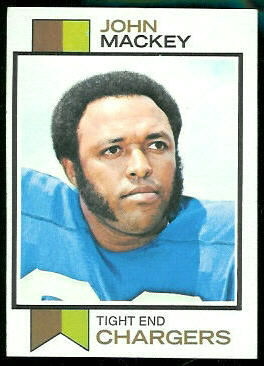
John Mackey, the Hall of Fame tight end, passed away on July 6th. Mackey played for the Baltimore Colts from 1963 to 1971 and for the San Diego Chargers in 1972. He was a five-time Pro Bowler for the Colts–three times on the first team–and he played in two Super Bowls: the Colts’ loss to the Jets in Super Bowl III and their win agains the Cowboys in Super Bowl V. He was elected to the Pro Football Hall of Fame in 1992.
The cards pictured here are Mackey’s rookie card, a 1964 Philadelphia, and his last card, a 1973 Topps. The 1973 card was actually issued after Mackey’s last season. You can see all of John Mackey’s football cards and stamps in the Vintage Football Card Gallery.
July 4th, 2011 |
Published in
Silly Stuff
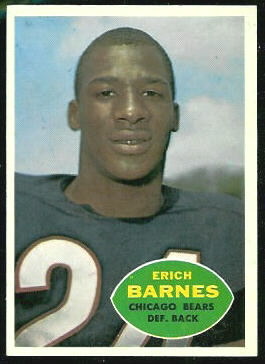
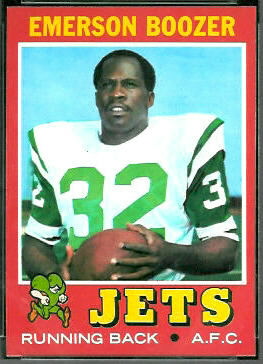
The holiday made me think of the movie, and thinking of the movie made me wonder what NFL players were born on the Fourth of July. I found the full list at pro-football-reference.com; the eight who appear in the Vintage Football Card Gallery are shown below. Wish them a happy birthday!
Six-time Pro Bowler Erich Barnes was born on July 4, 1935. Barnes’s rookie card, shown here, is a 1960 Topps. Two-time Pro-Bowler Emerson Boozer was born on July 4, 1943; he is shown here on his 1971 Topps card. (Boozer also appeared on my all-party team.)
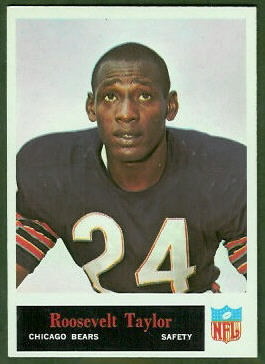
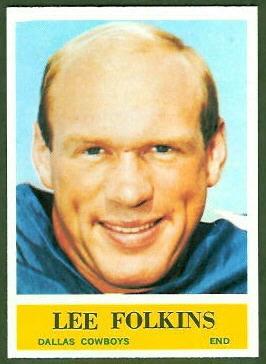
Two-time Pro Bowler Rosey Taylor was born on July 4, 1937; he is pictured here on his 1965 Philadelphia card. 1963 Pro-Bowler Lee Folkins was born on July 4, 1939; his rookie card, a 1964 Philadelphia, is shown here. (I heard from Mr. Folkins once. He told me that the signature on his 1964 Wheaties Stamp is not in his handwriting.)
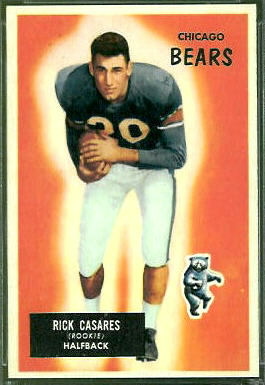
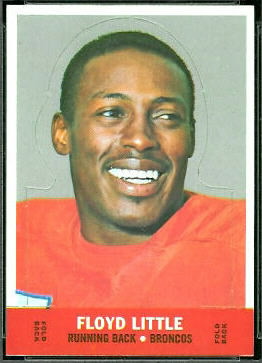
Five-time Pro-Bowler Rick Casares was born on July 4, 1931. His rookie card, shown here, is a 1955 Bowman. Hall of Famer Floyd Little was born on July 4, 1942; he is shown here on his 1968 Topps Stand Up insert card.
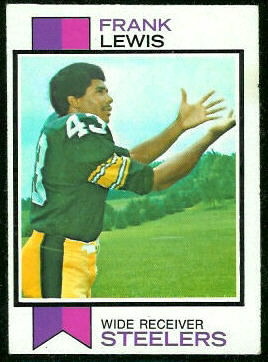
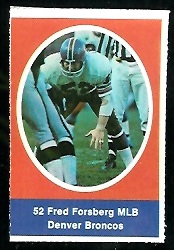
1981 Pro Bowler Frank Lewis was born on July 4, 1947; his rookie card, a 1973 Topps, is shown here. And, finally, Fred Forsberg was born on July 4, 1944. I don’t believe Forsberg appeared on a card, but I do have his 1972 Sunoco Stamp.
Enjoy your picnics!
Tags:
1955 Bowman,
1960 Topps,
1964 Philadelphia,
1965 Philadelphia,
1968 Topps Stand Up,
1971 Topps,
1972 Sunoco Stamps,
1973 Topps,
Emerson Boozer,
Erich Barnes,
Floyd Little,
Frank Lewis,
Fred Forsberg,
Lee Folkins,
Rick Casares,
Roosevelt Taylor
