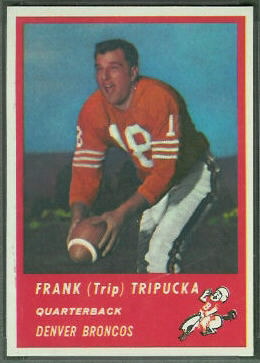
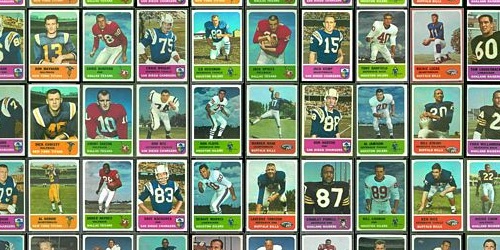
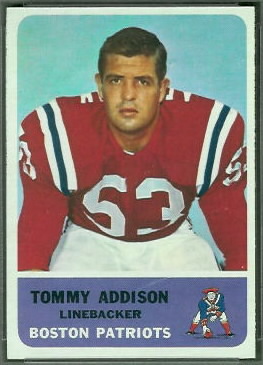
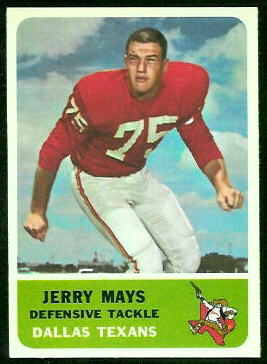
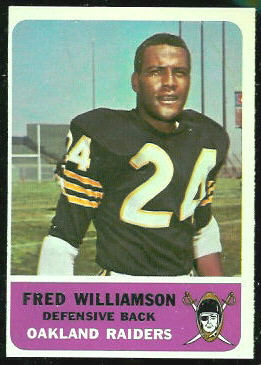
The Fleer Corporation printed football cards each year from 1960 to 1963. In 1960, 1962, and 1963, Fleer had rights to the AFL players, while their competitor, Topps, had rights to the NFL players. In 1961, both companies printed cards of both AFL and NFL players.
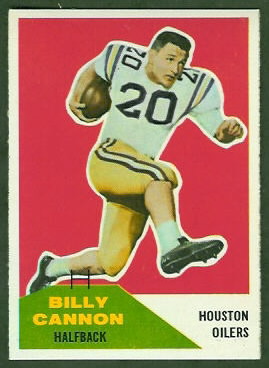 The 1960 Fleer set contains players and coaches from the original eight AFL teams. Since 1960 was the first year of the AFL, many of the players were coming to the league from college, and they are shown in their college uniforms. 1959 Heisman winner Billy Cannon is one example, in his LSU uniform. Other players are shown in uniforms of NFL teams they played for in prior years: George Blanda, for instance, is in a Bears uniform. Some of the players in the set were either cut before the season or did not get any playing time, judging by the records at pro-football-reference.com. Jim Woodard and George Blanch, both with the Raiders, are two players who do not appear on that site.
I recently created a page in the Vintage Football Card Gallery that shows a virtual uncut sheet of 1960 Fleer cards. As you can see on that page, an uncut sheet contained all 132 cards in the set, so no cards were short-printed. Because of where they were positioned on the sheet, however, some cards are much more difficult to find in high grade. The scarcest card is Jim Woodard, in the bottom left corner of the sheet. The corners of the uncut sheets evidently got damaged just as the corners of cards do.
The 1960 Fleer set contains the rookie cards of Hall of Famers Ron Mix, Hank Stram, and Sid Gillman, as well as the rookie cards of Jack Kemp and Heisman Trophy winner Billy Cannon. (Sid Gillman also has a pre-rookie card in the 1959 Bell Brand Rams set.)
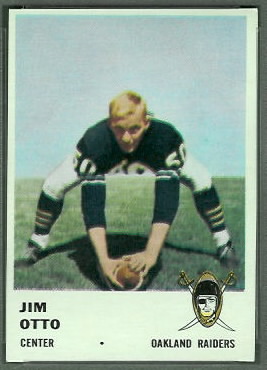 The 1961 Fleer set contains 220 cards, and it was released in two series: the first with 132 NFL players, the second with 88 AFL players. The cards in each series are sorted by team nickname. In the first series, the Bears cards are first, then the Browns, Cardinals, Colts, Cowboys, and so on to the Vikings. The second series has the Bills, Broncos, Chargers, etc. Interestingly, most of the photos of the NFL players show them standing, hands on hips, but most of the photos of the AFL players are action shots.
The 1961 Fleer virtual uncut sheet page shows what the second series sheets looked like, and it shows how the cards’ placement on the sheet has affected their availability in high grade. Though the price guides assign higher values to the second series cards, in reality they are more common than the first series cards, and they sell for less.
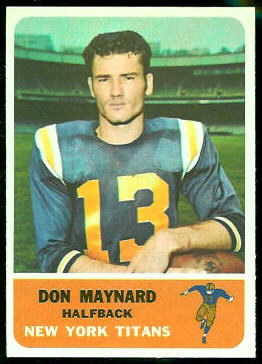
The 1961 Fleer set includes the rookie cards of two Hall of Famers, Jim Otto and Don Maynard, both AFL players. Because Topps also printed cards of AFL players in 1961, Otto and Maynard also have rookie cards in the 1961 Topps set. The 1961 Fleer set also contains two notable errors: the player on Goose Gonsoulin’s card is not Goose Gonsoulin, and the Packers logo is backward on every Green Bay Packers card.
Finally, the set reflects the changes to the leagues in 1961: the Vikings were an NFL expansion team, and the AFL’s Chargers moved from Los Angeles to San Diego.
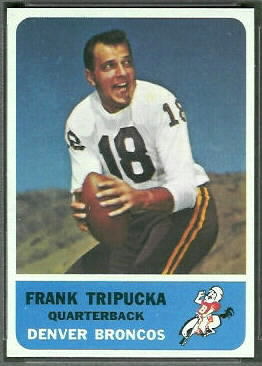
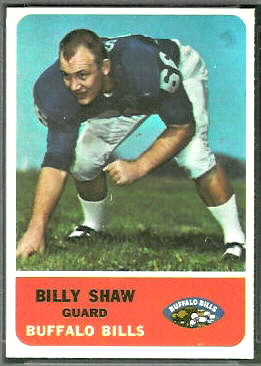 The 1962 Fleer set contains 88 cards, and it appears to have been printed in smaller numbers than the other Fleer sets. The cards are attractive, but they suffer from poor quality control: many of them were cut off-center, and many have large amounts of wax on the back. The cards are grouped and ordered by city: Boston first, then Buffalo, Dallas, Denver, Houston, New York, Oakland, and San Diego. I have not seen an uncut sheet, but because the first four cards in the set are scarce in high grades, I’ll bet that they were on the left edge, as they are were on sheets of 1963 Fleer cards.
The only Hall-of-Famer rookie card in the 1962 Fleer set is that of Billy Shaw. Shaw is the only player in the Pro Football Hall of Fame who never played in the NFL.
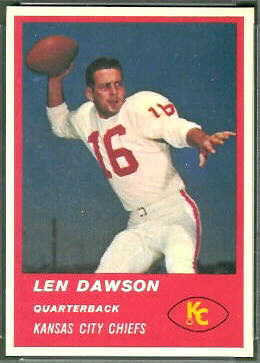 The 1963 Fleer set contains 89 cards: 88 players and an unnumbered checklist. The addition of the checklist caused the Bob Dougherty and Charles Long cards in the set to be short printed, as discussed on my virtual uncut sheet page for the set. The set also has a variation that none of the price guides acknowledges: cards with numbers divisible by 4 come both with and without a bottom stripe on the back. See the 1963 Fleer uncut sheet page for a discussion of that, too.
The 1963 set contains the rookie cards of three Hall of Famers: Len Dawson, Lance Alworth, and Nick Buoniconti. It also reflects the AFL’s two team changes in 1963: the Dallas Texans moved to Kansas City and became the Chiefs, and the New York Titans changed their nickname to the Jets. According to Wikipedia, the Titans were sold in 1963 and moved to Shea Stadium, which is close to LaGuardia Airport, and they hence became the Jets. One of the new owners was Leon Hess, founder of the Hess Corporation. The early Jets colors and logo were made to resemble Hess’s.
1963 marked the end of Fleer’s short run. In 1964, Philadelphia Gum Company obtained the rights to print cards of NFL players, and Topps in turn obtained the rights to the AFL.
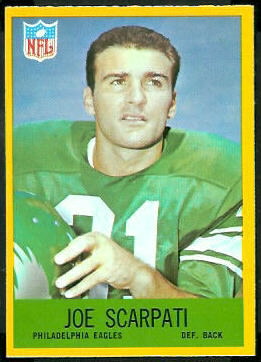
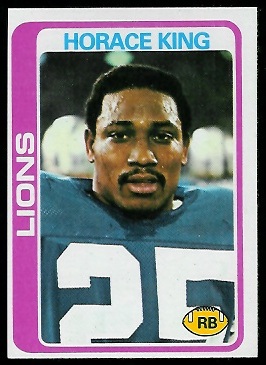
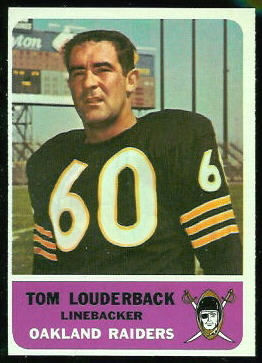 Three players in the Vintage Football Card Gallery are celebrating milestone birthdays today: Tom Louderback is 80, Joe Scarpati is 70, and Horace King is 60.