December 7th, 2023 |
Published in
Uncategorized
As you can see, it’s been a long time since I wrote in this blog. Back when I stopped, I decided I just didn’t have the time anymore. I have time again now, so I’ve started writing again. Rather than try to bring this blog up to date, though, I thought I’d just start a new one. It’s called Vintage Football Card of the Day, and it’s part of the Vintage Football Card Gallery. I hereby invite you to visit.
Some of the material here is still useful, I think, and I hope to gradually move the good stuff to the new blog or to the Gallery itself. You’re welcome to browse around, of course, but beware of broken links, missing images, and loose boards.
Hope to see you at the new place!
June 15th, 2014 |
Published in
Football Card Trivia, Uniforms
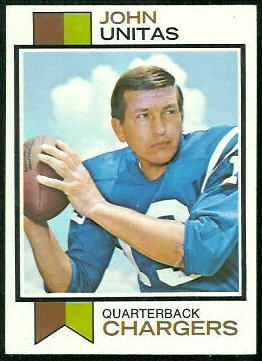
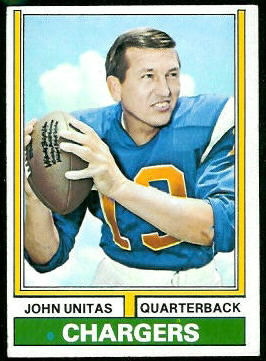
Ever notice that John Unitas’s 1974 Topps card pictures him still in his Colts uniform, but with the jersey numbers colored yellow to look more like a Chargers uniform? Yesterday was the first time I noticed this. Here are his 1973 and 1974 Topps cards, side by side.
Though he appeared on a card in 1974, Unitas did not play that year. He retired on July 23.
June 8th, 2014 |
Published in
Miscut Cards and Uncut Sheets
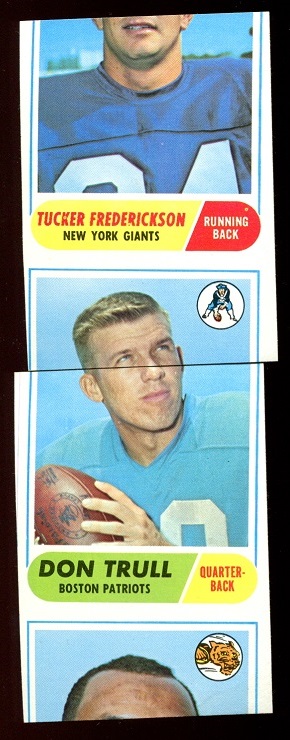
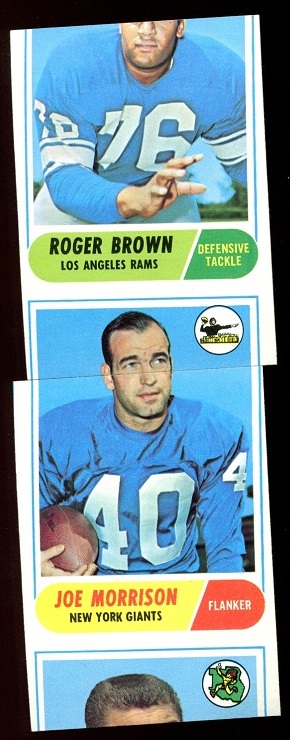
This morning I added a new page to the Vintage Football Card Gallery called Miscut Madness! I have handled a lot of miscut cards, naturally, and this page shows the worst of them. Below are some examples; visit the new page to see the rest. I will add more as I get them in.
April 8th, 2014 |
Published in
CFL Cards, My Collection

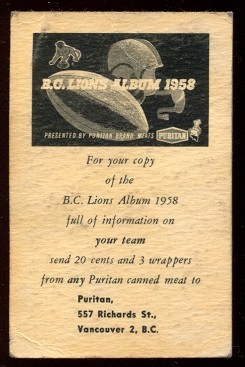 Here are the latest additions to my own collection: two 1958 Puritan Meats BC Lions football cards. According to Beckett, there are 50 cards in the set, and they were distributed with Puritan canned meat products. They are 2 1/4 by 3 3/8″, and they are on thicker-than-normal cardboard. The backs of these two cards are the same, and I presume that the rest of the cards also have the same back. (You can click on the images to see slightly bigger versions.)
Howard Schnellenberger played two years in the CFL, then went on to a long coaching career, including two years as head coach of the Baltimore Colts. Ted Hunt played for BC for two seasons, and he also excelled at lacrosse, skiing, and boxing. Hunt was inducted into the BC Sports Hall of Fame in 1972.
These are the first two cards I have found from the set. If I get a few more, I’ll add the set to the Canadian section of the Vintage Football Card Gallery.
March 12th, 2014 |
Published in
CFL Cards, New in the Gallery
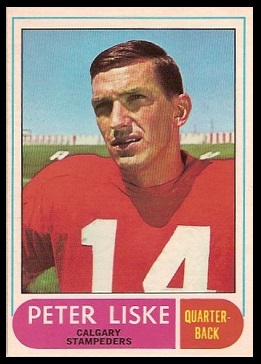 Last week I finished adding 1968 O-Pee-Chee CFL football cards to the Vintage Football Card Gallery. As I have said before, one thing I enjoy about browsing CFL sets is finding players who also played in the NFL or AFL. The 1968 O-Pee-Chee set contains several players who had brief NFL or AFL careers, but who never appeared on an American football card.
The 1968 O-Pee-Chee set also includes one player, Pete Liske, who appeared on AFL, NFL, and CFL cards. He is now the fifth player to appear on my Cards in Three Leagues page. Liske was named the CFL’s Most Outstanding Player in 1967.
A huge thanks to CFL collector Larry Oleskiw, who provided the images for the 1968 O-Pee-Chee set. Larry also sent me images for several other Canadian sets, and I will add those to the Gallery as I have time.
March 1st, 2014 |
Published in
Miscut Cards and Uncut Sheets, New in the Gallery
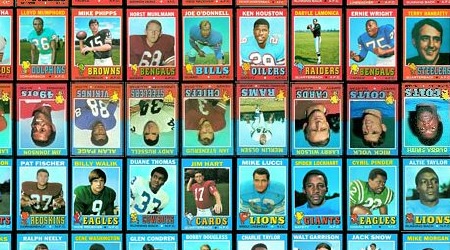
Yesterday I added virtual uncut sheets of 1971 Topps football cards to the Vintage Football Card Gallery. The sheets are not quite complete, but if you happen to have any badly miscut 1971 Topps cards in your collection, perhaps you can help fill in the holes. Click on the image below to see the sheets so far.
The Gallery now includes virtual uncut sheets, partial and whole, for 29 football card sets. For the full list, see one of my previous blog articles, U is for Uncut Sheets.
February 11th, 2014 |
Published in
error cards
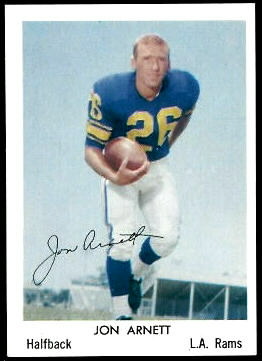
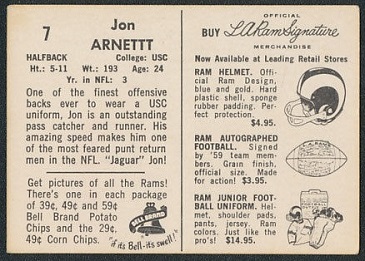
This might be the worst spelling error I have seen on a card, but it is not marked in the major price guides: on the back of Jon Arnett’s 1959 Bell Brand Rams card, his last name is misspelled “Arnettt,” with three t’s!
You can see all of the error cards in the Vintage Football Card Gallery here.
January 18th, 2014 |
Published in
error cards, Where They Are Now
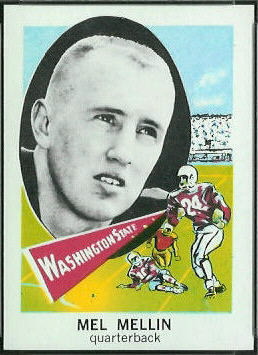 Error card collectors, here is another error card that is not marked in the price guides: on Mel Melin’s 1961 Nu-Card card, his last name is misspelled “Mellin.” Thanks to Philip, a visitor to my web sites, for pointing that out.
After starring at Washington State, Melin went on to play four seasons for the CFL‘s BC Lions. He appeared on at least one football card with BC, a 1963 Post Cereal CFL card. I don’t yet have the 1963 Post CFL set in the Vintage Football Card Gallery, but you can probably see the Melin card on eBay.
For more on Mr. Melin, check out “Where Are They Now: Mel Melin” on the Washington State University web site. To see more errors on old football cards, see the error card search page of the Vintage Football Card Gallery.
January 12th, 2014 |
Published in
Miscut Cards and Uncut Sheets, New in the Gallery
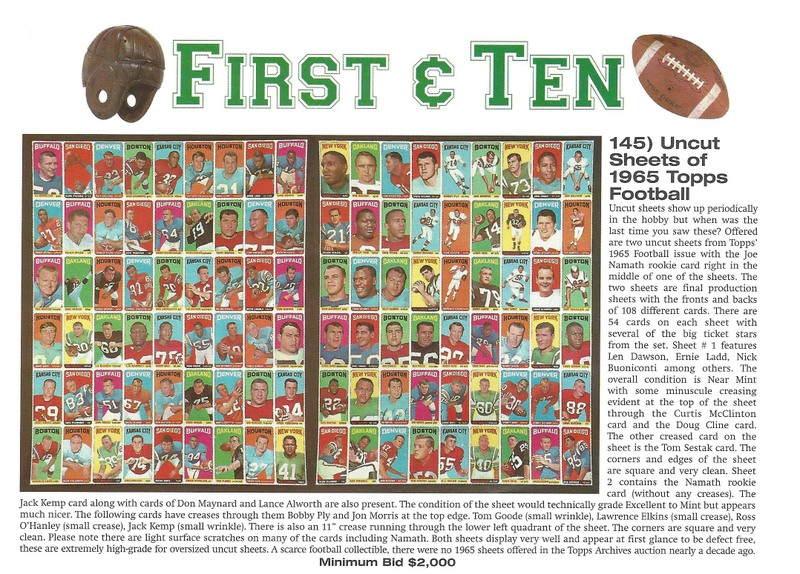
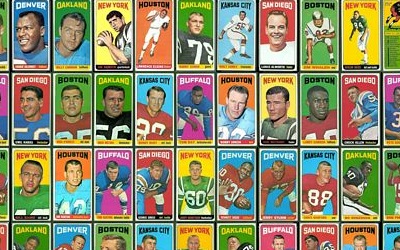
My friend John recently dug up an ad from an old auction catalog that shows two sections of a sheet of 1965 Topps football cards. This week I incorporated those sections into the 1965 Topps virtual uncut sheet page I had already started. You can check out the page to see my progress. If you happen to see more partial sheets or badly miscut cards that will help the effort, please send me an email.
December 21st, 2013 |
Published in
Interactive Team Cards, New in the Gallery
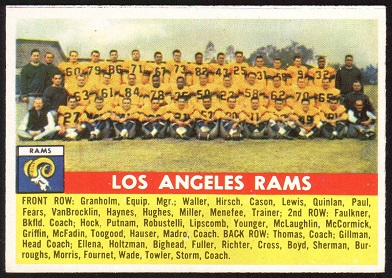
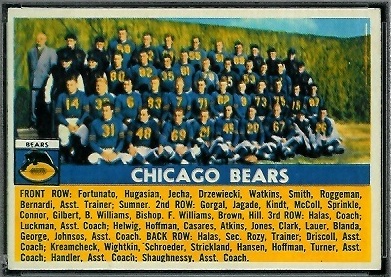 Last week I added interactive 1956 Topps Los Angeles Rams and Chicago Bears team cards to the Vintage Football Card Gallery. You can see them by clicking on the non-interactive images shown here.
Like the other team cards in the 1956 Topps set, these two cards picture the 1955 teams. I believe that all of the players on the Rams card also appear in the 1955 Rams Team Issue set. About six of the players on the Bears card never appeared on cards of their own, so it was nice to give them a little recognition. One of the Bears players, Harry Hugasian, played part of the 1955 season for Baltimore, and he also appears on the Colts team card.
I have now finished making all of the 1956 Topps team cards intereractive; you can see the whole array here. Next up are the team cards in the 1958 Topps set.