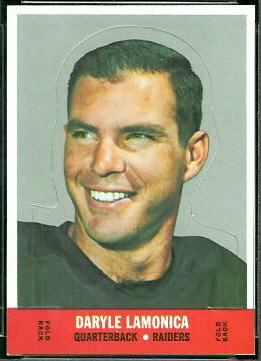
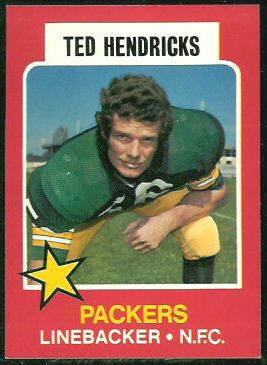
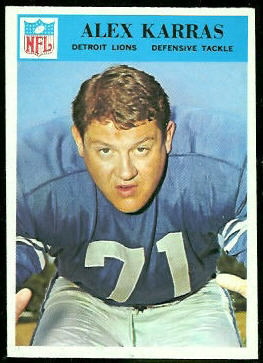
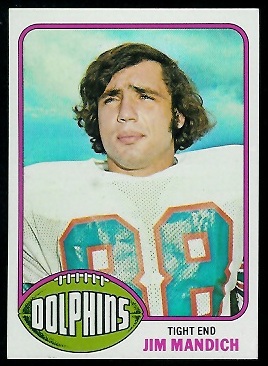
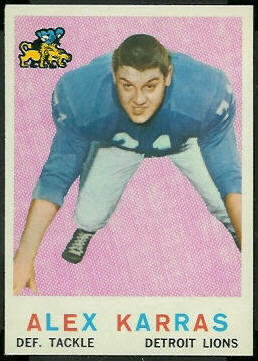
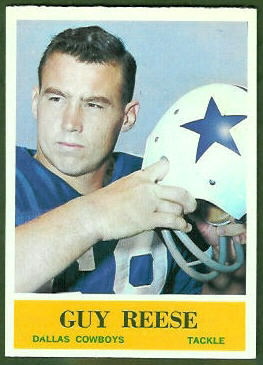
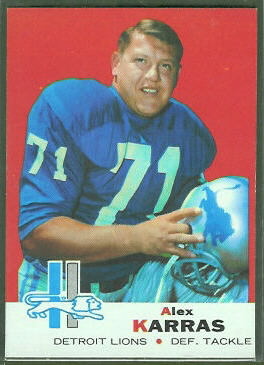
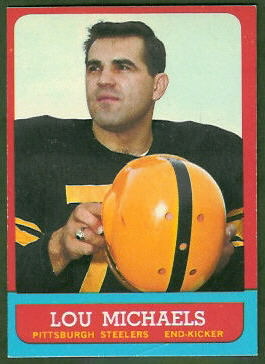
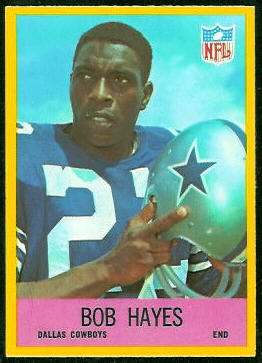
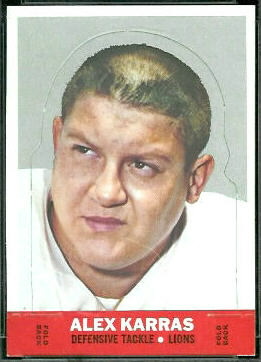
 Compared to quarterbacks, running backs, receivers, and even kickers, defensive players often got short shrift when the card companies chose the players to put on their cards. The 1968 Topps Stand Up insert set is an extreme example of the bias toward offensive players: in the 22-card set there is only one defensive player, Alex Karras. Even he might not have been included if the 1968 Lions had had an offensive star. Another example, the 1970 Topps Super Glossy set, is somewhat less unbalanced: it contains 25 offensive players, 7 defensive players, and 1 kicker.
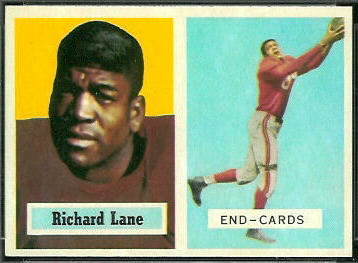 Numerous Hall of Fame defensive players were in the league for years before appearing on a card. The most egregious example I can think of is Dick Lane. In 1952, his rookie year with the Rams, Lane had 14 interceptions, an NFL record that still stands–and he did it in 12 games! In 1954 he again led the league in interceptions, with 10, this time with the Cardinals. Despite his performance–and though the Cardinals were hardly flush with stars–Lane first appeared on a 1957 Topps card, and his next appearance was on a 1961 Fleer. (Lane’s biography on Wikipedia–assuming it is accurate–is fascinating. It says his mother found him in a Dumpster!)
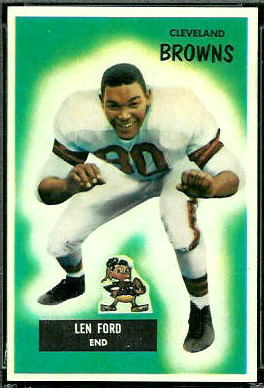 Another Hall of Fame defensive player, Len Ford, played for 11 years but appeared on only two cards: his 1955 Bowman rookie card and a 1957 Topps card. He began his career in 1948 with the Los Angeles Dons of the AAFC, and he joined the Browns in 1950 when the AAFC folded and the Browns joined the NFL. No major company printed cards of AAFC players, but Bowman printed cards of NFL players every year from 1950 to 1955, and they finally included Ford in their last year.
At least four Lombardi-era Packers defensive players also made late rookie card appearances: Ray Nitschke began his career in 1958, and his rookie card is a 1963 Topps. Willie Davis also joined the team in 1958, and his rookie card is a 1964 Philadelphia. Herb Adderley joined the team in 1961, and his rookie card is also a 1964 Philadelphia–with his name misspelled, to boot. Willie Wood started in 1960, and his rookie card is a 1963 Topps.
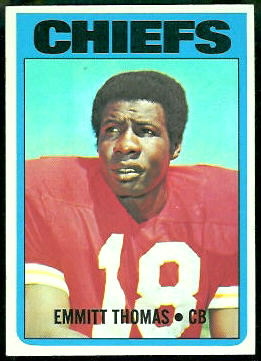 Two Chiefs Hall of Fame defensive backs provide a final example: Willie Lanier joined the Chiefs in 1967, and his rookie card is a 1971 Topps. Emmitt Thomas joined in 1966, and his rookie card is a 1972 Topps.
Occasionally, when it took a while for a defensive player to appear on a card from a major company, the player would appear first on a “pre-rookie” card in a regional or oddball set. All four of the Packers mentioned above had pre-rookie cards in the 1961 Lake to Lake Packers set. Hall of Famers Bob Lilly, Jim Johnson, and Larry Wilson all had pre-rookie cards in the 1962 Post Cereal set. And as I wrote in a previous post, Rams star Ed Meador appeared on 1959 Bell Brand, 1960 Bell Brand, and 1962 Post Cereal cards before his 1963 Topps rookie card was issued. Another long-time Ram, Jack Pardee, whose rookie card is a 1964 Philadelphia, also appeared in the Bell Brand and Post Cereal sets.
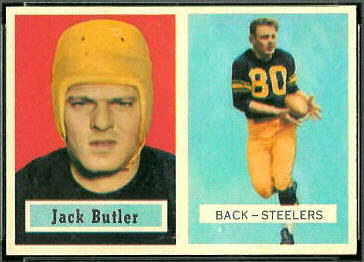 Changing the subject a bit, it is worth noting that until 1959, football cards did not distinguish between offensive and defensive positions when there was ambiguity. For example, if a player’s card said “end,” he could have been either a receiver or a defensive end. If it said “back,” he could have been either a running back or a defensive back. Pictured here is an example: Jack Butler was a defensive back, but his 1957 Topps rookie card just says “back.” (This, by the way, is another late rookie card. Butler started his career with the Steelers in 1951.) Perhaps this was a vestige of the time when players played both offense and defense, and a back on offense would also have been a back on defense. Whatever the reason, because of the ambiguity, I probably still have some defensive players listed as offensive players in the Vintage Football Card Gallery. Occasionally a kind person sends me a correction.
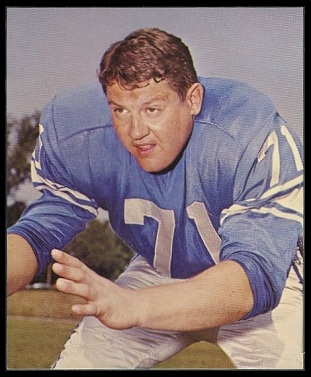 Did you know that Alex Karras finished second in voting for the Heisman Trophy in 1957? I didn’t, until I saw his name on the Heisman Trophy web site. While browsing the Heisman site, I also found other players whose cards I have, but whom I hadn’t known were Heisman candidates. I thought that a page featuring these candidates and their cards would be interesting, so I assembled one and added it to the Vintage Football Card Gallery. Have a look!