April 4th, 2013 |
Published in
Brothers, Milestone Birthdays
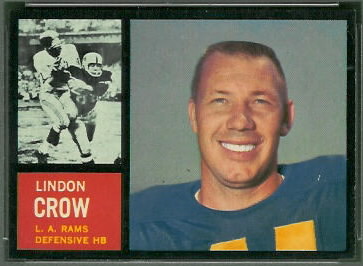 Former NFL defensive back Lindon Crow is celebrating his 80th birthday today. Crow played from 1955 to 1964 for the Chicago Cardinals, New York Giants, and Los Angeles Rams. In 1956, his second season, he led the league with 11 interceptions. He played in two NFL Championship games, both with the Giants, in 1958 and 1959. The Giants lost both games to the Baltimore Colts.
Crow’s younger brother, Wayne Crow, also played professional football. He was a halfback and punter for four seasons with the AFL’s Oakland Raiders and Buffalo Bills.
Crow appeared on football cards with all three of his NFL teams. My favorite, his 1962 Topps card, is pictured here. You can see the rest of his cards in the Vintage Football Card Gallery.
According to oldestlivingprofootball.com, Crow is the 494th oldest living American pro football player.
Happy birthday, Mr. Crow!
March 15th, 2013 |
Published in
New in the Gallery
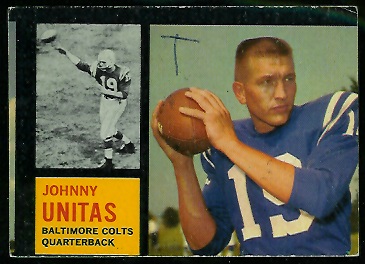 Yesterday, via an eBay purchase, I obtained another card that will help me figure out how 1962 Topps football cards were arranged on uncut sheets. The John Unitas card shown here has a sliver of Bill Forester’s card on the left. This bit of information let me add the Unitas to a piece of the uncut sheet I already had. To see where the new piece fit, scroll toward the bottom of the 1962 Topps virtual uncut sheet page of the Vintage Football Card Gallery. Another ten years, and I should have it finished!
For other virtual uncut sheets, some completed and some not, see a previous article, U is for Uncut Sheets.
January 19th, 2013 |
Published in
New in the Gallery

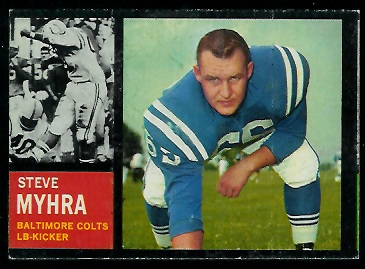 This week I picked up two more miscut cards that will help me figure out how 1962 Topps football cards were arranged on the uncut sheets. The Boyd Dowler card shown here has a sliver of Roger LeClerc’s card on the right, and the Steve Myhra card has a bit of Joe Walton’s card on the right. Both of these clues let me add on to pieces of the puzzle I already had. You can see my progress on the 1962 Topps virtual uncut sheet page of the Vintage Football Card Gallery. Scroll toward the bottom to see where the new pieces fit.
Why are uncut sheets interesting? See a previous article, U is for Uncut Sheets.
January 4th, 2013 |
Published in
Player Deaths
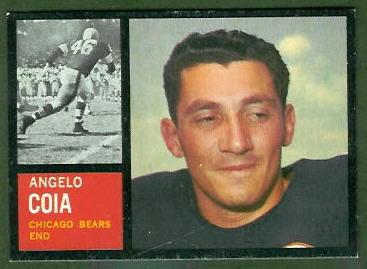 Angelo Coia, a receiver from 1960 to 1966 for the Chicago Bears, Washington Redskins, and Atlanta Falcons, passed away on January 2. Coia was a member of the Bears team that won the NFL Championship in 1963. He also was a member of the first Falcons team, in 1966. According to Coia’s obituary at philly.com, he and Herb Adderley were teammates on the football and track teams at Northeast High School in Philadelphia. He played college football at The Citadel and USC.
Coia is pictured here on his rookie card, a 1962 Topps. He also appeared on a 1962 Post Cereal card and a 1965 Philadelphia football card.
November 28th, 2012 |
Published in
New in the Gallery
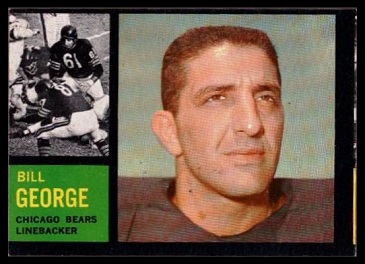 I have seen one half of a sheet of 1962 Topps football cards, but not the second half. By looking at badly miscut cards, however, I have been able to start piecing the second half-sheet together. You can tell from this Bill George card, for instance, that Dave Baker’s card was next to it on the uncut sheet. Neither of the cards appear on the one half-sheet I have seen, so they must have been on the second half-sheet.
To see the layout of the first half-sheet and my progress on the second half-sheet, see my 1962 Topps virtual uncut sheet page. For a full list of the virtual uncut sheets I have assembled, see a previous blog article, U is for Uncut Sheets.
December 1st, 2011 |
Published in
error cards, Football Card Trivia
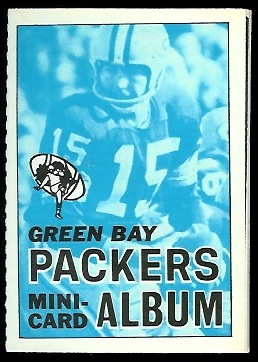
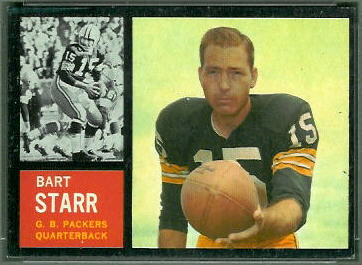
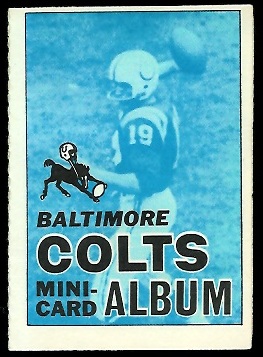
As I wrote last week, one of my readers pointed out that the player on the cover of the San Francisco 49ers 1969 Topps Mini-Card Album is Joe Walton, and that the same image appeared in the inset photo of Walton’s 1962 Topps football card. This made me curious, so I checked to see if other inset photos from 1962 Topps cards had been reused on 1969 Mini-Card Albums. Sure enough, I found a few:
First, the image of Bart Starr on the Green Bay Packers Mini-Card Album appeared in the inset of Starr’s 1962 Topps card.
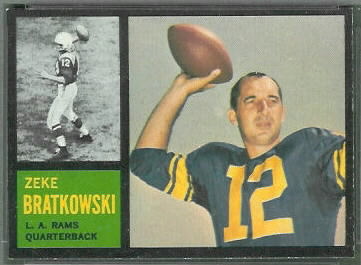
Next, the image of John Unitas on the Baltimore Colts Mini-Card Album was also used in the inset photo of Zeke Bratkowski’s 1962 Topps card. Topps changed Unitas’s number 19 to Bratkowski’s number 12 on the 1962 Topps card, as I noted in an earlier article.
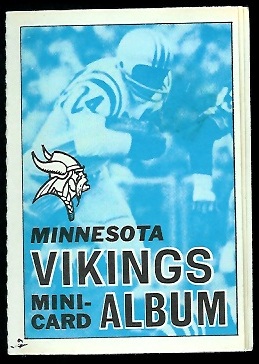
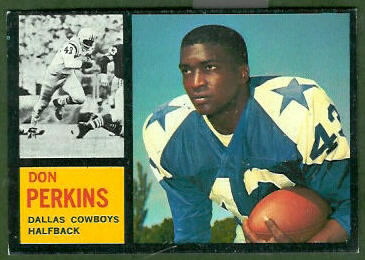
The image on the Minnesota Vikings Mini-Card Album also appeared in the inset photo of Don Perkins’s 1962 Topps card, but the player’s number is different. I’m guessing that the image was altered for the 1962 card, so the player probably isn’t Perkins.
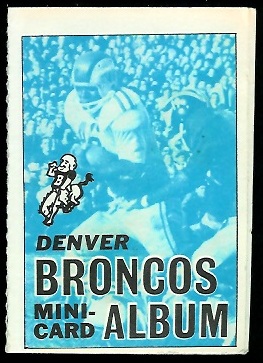
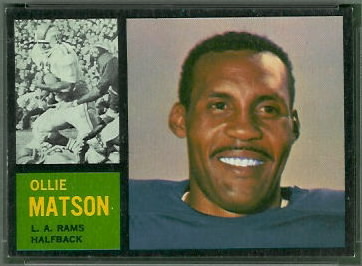
The image on the Denver Broncos Mini-Card Album is the same one used in the inset photo on Ollie Matson’s 1962 Topps card, but again, the player’s number is different. Matson was number 33 with the Rams, so it appears that the image on his 1962 card was altered. Does anyone recognize the player?
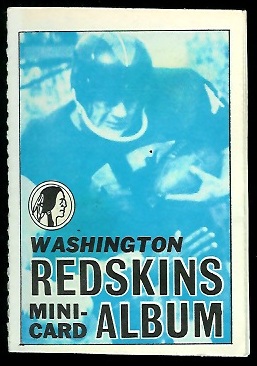
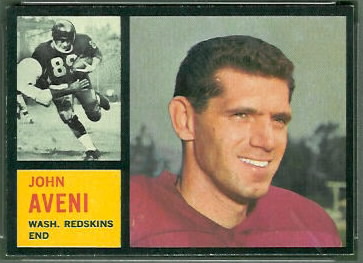
Finally, the image on the Washington Redskins Mini-Card Album is the same as the inset on John Aveni’s 1962 Topps card. Again, the player’s number appears to have been changed on the 1962 Topps card. I believe that the player is Dick James, who wore number 47 for the Redskins in 1961.
Given that there are so many altered jersey numbers on the 1962 Topps cards, I wonder how many of the inset photos actually picture the right player. Not many, I’ll bet.
Tags:
1962 Topps,
1969 Topps Mini-Card Albums,
Baltimore Colts,
Bart Starr,
Denver Broncos,
Don Perkins,
Green Bay Packers,
John Aveni,
John Unitas,
Los Angeles Rams,
Minnesota Vikings,
Ollie Matson,
Washington Redskins,
Zeke Bratkowski
December 24th, 2010 |
Published in
Silly Stuff
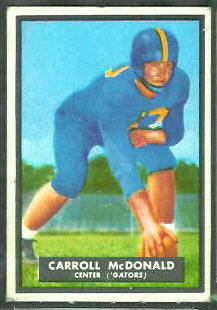
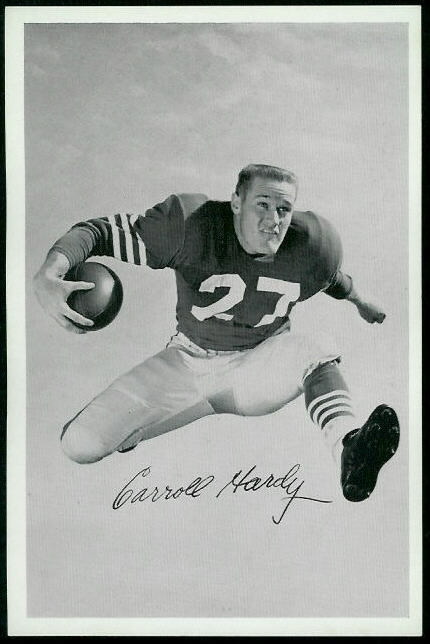
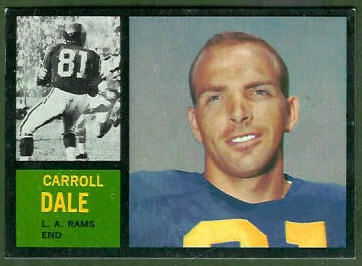 Merry Christmas! What better way to celebrate than with a few Carrolls? Here we have a 1962 Topps Carroll Dale, a 1951 Topps Magic Carroll McDonald, and a 1955 49ers Team Issue Carroll Hardy. I tried putting little Santa hats on them, but that didn’t go very well, so I left them hat-less.
Enjoy your families, feasts, and football games!
December 16th, 2010 |
Published in
General Collecting Info, New in the Gallery
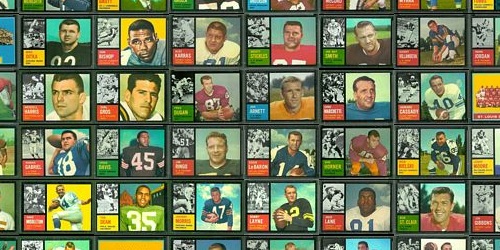
Yesterday I added a virtual uncut sheet of 1962 Topps football cards to the Vintage Football Card Gallery. Looking at the sheet–and having looked at numerous other uncut sheets–I convinced myself that the price guides have misidentified many of the short prints in this set. I would be interested in your feedback.
(Click the image to see the uncut sheet page.)
December 3rd, 2010 |
Published in
Where They Are Now
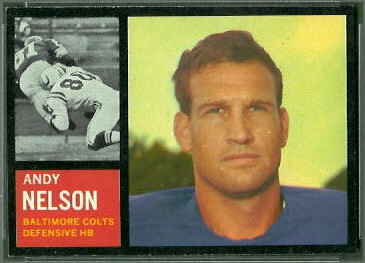 Last week I talked with a customer who collects football cards of University of Memphis (formerly Memphis State University) alumni, and he told me about the web sites of two alumni, Andy Nelson and John Bramlett. It was interesting to see where the players were now, so I thought I’d pass the web sites along. If I find enough sites of former players, I’ll create a page to summarize them.
Andy Nelson, after graduating from Memphis, played eight seasons with the Baltimore Colts. His 1962 Topps card is pictured here, and he also appeared on a 1959 Topps card. After retiring from football, Nelson founded Andy Nelson’s Barbeque, in Cockeysville, Maryland. The business still appears to be going strong. (I thought about joining Andy’s Swine Social Club, but I live kind of far away.) There’s a recent picture of Nelson in a Baltimore Examiner article about the restaurant.
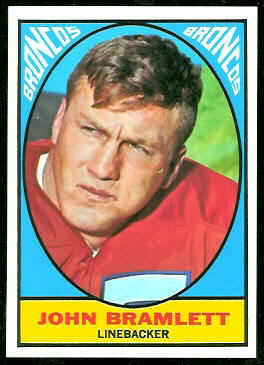 Another Memphis grad, John “Bull” Bramlett, played seven seasons for the Broncos, Dolphins, Patriots, and Falcons. The card pictured here is Bramlett’s rookie card, a 1967 Topps; he also appeared on a 1969 Topps 4-in-1 insert and a 1971 Topps card. After football, Bramlett started John Bramlett Ministries, in Cordova, Tennessee. The web site includes a few recent photos of Bramlett.
September 11th, 2010 |
Published in
Halls of Fame, New in the Gallery, Uniforms
This morning I added the ability to search the Vintage Football Card Gallery for members of the Dallas Cowboys Ring of Honor. Just go to the Advanced Search page, choose Cowboys Ring of Honor in one of the “Honor” menus, and hit the Search button.
Pictured here is one member of the Ring, Don Perkins, on his 1962 Topps rookie card. He’s wearing the Cowboys’ first home jersey, my all-time favorite over all the NFL teams. He doesn’t appear to be wearing it in the black-and-white inset photo, though, so I wonder if that is a college photo. Or maybe it’s not even him: on some 1962 cards, Topps pictured a different player in the inset photo, sometimes altering the image to look like the player on the card. For examples of that, see my earlier blog article on the subject.
Looking through the cards I have of members of the Cowboys Ring of Honor, it’s striking that there are no cards of players who had moved on to different teams. It is possible that I don’t have all of the players’ cards, but the impression I get is that the Cowboys’ best players stayed with the Cowboys.
