June 24th, 2013 |
Published in
New in the Gallery
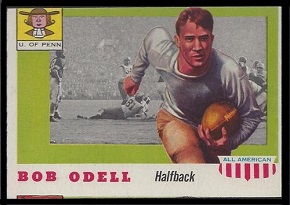 Yesterday, by looking at some miscut cards, I was able to add a few pieces to my virtual uncut sheet of 1955 Topps All-American football cards. One of the miscuts is pictured here: a Bob Odell card with a bit of Elmer Oliphant’s card showing along the bottom. As I find more of these, I hope to be able to piece together the whole 220-card sheet.
Check out my progress, and if you have any miscut cards that might help the effort, please send them my way.
April 2nd, 2013 |
Published in
Brothers, error cards, New in the Gallery
You learn something every week. 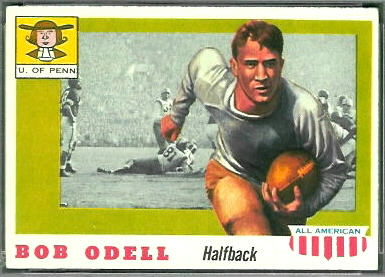 This week I learned from a post in the Collectors Universe forums that the player pictured on Bob Odell’s 1955 Topps All-American card is not Bob Odell. The impostor is Howard Odell, Bob’s older brother, who played at the University of Pittsburgh. For details–and to see many more cards that picture the wrong player–see the Mistaken Identities page of the Vintage Football Card Gallery.
March 11th, 2013 |
Published in
Brothers, Fathers and Sons, New in the Gallery
As I wrote in a previous article, I am converting some of my more popular blog articles into standard web pages and moving them to the Vintage Football Card Gallery. I am finding that blog articles work best for news, and standard pages work better for information that is not time-sensitive.
This weekend I converted my Fathers and Sons and Teammate Brothers blog articles into gallery pages. In the process, I added a few fathers, sons, and brothers who are new to the Gallery since I wrote the original articles. The new pages are in the Fun Pages section of the Gallery home page. While you’re over there, check out the other pages to see if you’ve missed any new ones.
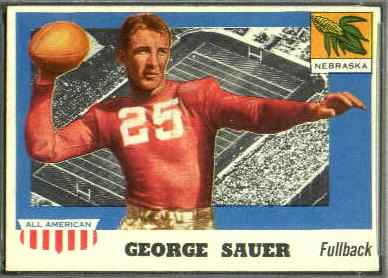
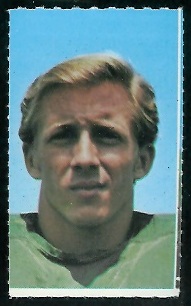
What is your favorite father/son or brother/brother football card pair? Here’s mine: George Sauer Sr. on his 1955 Topps All-American card, and George Sauer Jr. on his 1969 Glendale Stamp. There’s quite a resemblance, don’t you think?
June 17th, 2012 |
Published in
Fathers and Sons
As I have mentioned in other articles, I have been gradually adding fun facts for the cards in the Vintage Football Card Gallery. In May I identified the players whose brothers also played pro football (see my blog article Teammate Brothers), and this month I marked the players whose fathers or sons also played professionally. I used the Pro Football Hall of Fame’s list as a reference.
Many of the players on the Hall of Fame’s list never appeared on cards, and some of them appeared on newer cards that I don’t yet have in the Gallery. I did find five pairs of fathers and sons who both appear in the Gallery, though. In honor of Father’s Day, here they are:
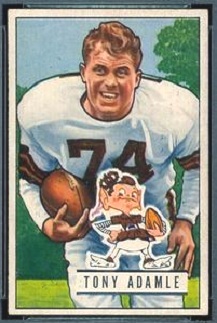
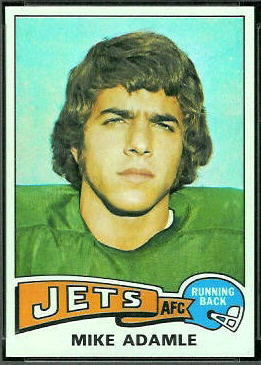
Tony Adamle played six seasons for the Cleveland Browns in the AAFC and NFL; his son Mike played six seasons for the Chiefs, Jets, and Bears. Tony is pictured here on his 1951 Bowman card, and Mike on his 1975 Topps card.
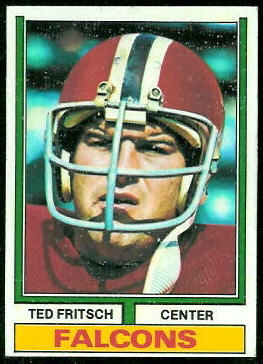
Ted Fritsch Sr., a member of the Green Bay Packers Hall of Fame, played from 1942 to 1950 for the Packers. Ted Fritsch Jr. played from 1972 to 1979 for the Falcons and Redskins. Ted Sr. appears here on his 1950 Bowman card; Ted Jr. is shown on his 1974 Topps card.
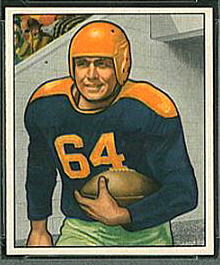
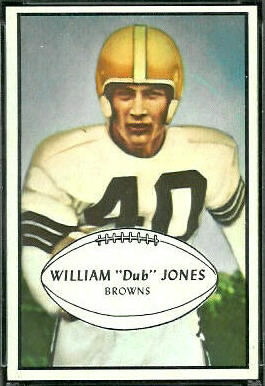
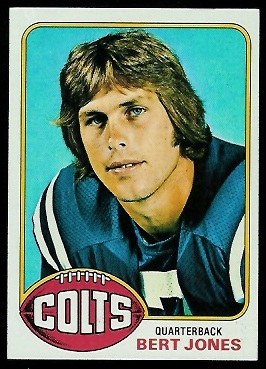
Dub Jones played for the Miami Seahawks, Brooklyn Dodgers, and Cleveland Browns in the AAFC, and he remained with the Browns when they joined the NFL in 1950. He is shown here on his 1953 Bowman card. Bert Jones, Dub’s son, was a quarterback for ten seasons with the Baltimore Colts and Los Angeles Rams. His 1976 Topps card is shown here.
George Sauer Sr. played from 1933 to 1935 for the Green Bay Packers; he is shown here on his 1955 Topps All-American card. George Jr. played from 1966 to 1970 for the New York Jets; he is shown on a 1969 Glendale stamp.
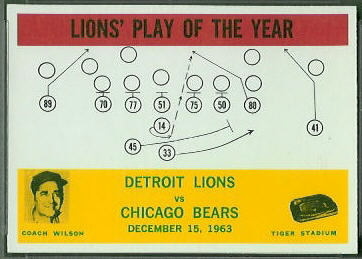
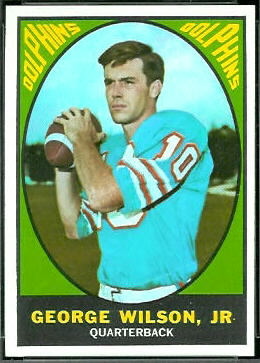
Finally, George Wilson Sr. played for the Chicago Bears for ten seasons, and he was head coach of the Detroit Lions and Miami Dolphins for thirteen. Wilson never appeared on a card of his own, but there is a small image of him on the 1964 Philadelphia Lions’ Play card shown here. Wilson’s son, George Jr., played for his father for one season at Miami. His 1967 Topps card is shown here.
Tags:
1950 Bowman,
1951 Bowman,
1953 Bowman,
1955 Topps All-American,
1964 Philadelphia,
1967 Topps,
1969 Glendale Stamps,
1974 Topps,
1975 Topps,
1976 Topps,
Baltimore Colts,
Bert Jones,
Cleveland Browns,
Detroit Lions,
Dub Jones,
George Sauer Jr.,
George Sauer Sr.,
George Wilson Jr.,
George Wilson Sr.,
Green Bay Packers,
Miami Dolphins,
Mike Adamle,
New York Jets,
St. Louis Cardinals,
Ted Fritsch Jr.,
Ted Fritsch Sr.,
Tony Adamle
May 17th, 2012 |
Published in
Milestone Birthdays
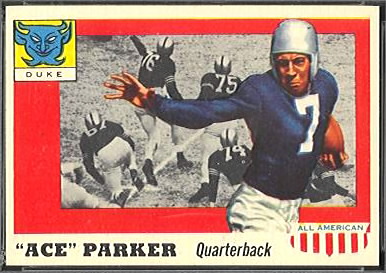 Clarence “Ace” Parker, the oldest living pro football player, is 100 years old today. Parker played from 1937 to 1941 for the NFL’s Brooklyn Dodgers, served three years in World War II, then returned to play one season for the NFL’s Boston Yanks and one season for the AAFC’s New York Yankees. At various times in his career he was a tailback, defensive back, kicker, punter, and kick returner. He was elected to the Pro Football Hall of Fame in 1972.
Parker also played two seasons of major league baseball, for the American League’s Philadelphia Athletics. Today’s New York Times has a detailed account of his athletic career.
The card pictured here is Parker’s 1955 Topps All-American card. He also appeared on a 1975 Fleer Immortal Roll football card.
For a list of the 500 oldest living pro football players, see oldestlivingprofootball.com.
December 27th, 2011 |
Published in
Fathers and Sons, Football Card Trivia
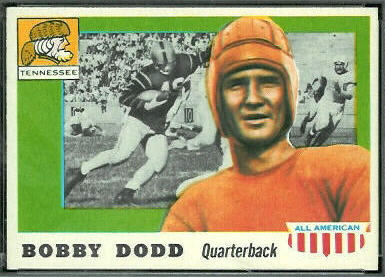
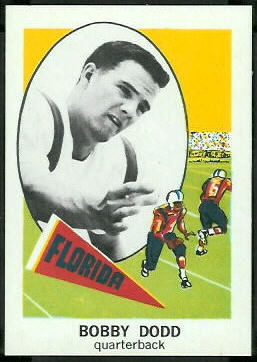 It’s not unusual to encounter football cards of players who have the same name. Among others, I have cards of two J.D. Smiths, two Gene Washingtons, two Bob Boyds, and three Bob Browns. I also have cards of two Bobby Dodds, but it was only yesterday that I learned that they were father and son. Bobby Dodd Sr. appeared on a 1955 Topps All-American card, and Bobby Dodd Jr. appeared in the 1961 Nu-Card set. I believe these were their only cards.
Dodd Sr. was elected to the College Football Hall of Fame as both a player at Tennesse and a coach at Georgia Tech. Dodd Jr. was a quarterback and defensive back at Florida. From what I can tell, they met on the field three times, when Georgia Tech played Florida in 1960, 1961, and 1962. Florida won the 1960 game on a last-minute two-point conversion, and Georgia Tech shut out the Gators in 1961 and 1962.
November 4th, 2011 |
Published in
error cards, Sites I Like
 While doing some web searches the other day, I ran across a long page of photos of Bo McMillin. McMillin was an All-American quarterback at Centre College in 1919 and 1921, and he played a few games in the NFL with the Milwaukee Badgers and Cleveland Indians. After his playing days, he had a long coaching career, including four seasons as an NFL head coach. There is a short biography of McMillin on the Centre College web site.
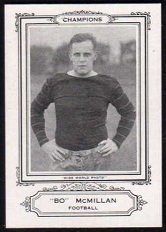 Reading the commentary in the long page of photos, I learned that McMillin’s name is misspelled on both his 1955 Topps All-American card and his 1926 Spalding Champions card. It is spelled correctly in my Beckett price guides, but the cards are not noted as errors, so the errors were news to me. I also learned from the photo page that the image on McMillin’s 1926 Spalding card is not McMillin, but another player. If you put the card next to one of his other photos, it is clear that the Spalding card pictures someone else. Does anyone recognize the impostor?
Having learned about the mistakes, I fixed the spelling of McMillin’s name on my two web sites, noted the errors on his individual cards, and added his 1926 Spalding card to my page of football cards that picture the wrong player. Whew!
August 21st, 2011 |
Published in
New in the Gallery
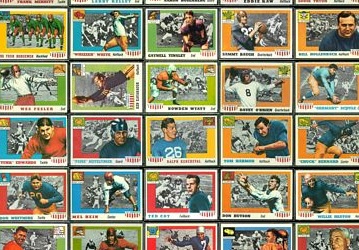 While surfing the web this week, I found a picture of a partial sheet of 1955 Topps All-American football cards. The partial sheet contains 50 cards, half of the 100 cards in the complete set. Today I created a virtual version of it and added it to the Vintage Football Card Gallery. For now it’s on my “In Progress” page, but I will probably promote it to its own page when I get time.
October 15th, 2010 |
Published in
Football Card Trivia, Player Deaths
Ralph Kercheval, who had been the oldest living pro football player, passed away on October 6. He was 98 years and 10 months old. I wrote a short article about Kercheval and his football cards last year.
With Kercheval’s passing, Ace Parker, a member of the Pro Football Hall of Fame, became the oldest living pro football player. According to his Wikipedia page, Parker is 98 years and 5 months old. To my knowledge, the 1955 Topps All-American card pictured here is Parker’s only vintage card, though he appeared in a few modern tribute sets, as well. You can find many of his tribute cards on eBay.
Parker also played two seasons for baseball’s Philadelphia Athletics, but I don’t know if he is also the oldest living major league baseball player. I did a quick net search for Ace Parker baseball cards, but I didn’t turn any up.
The Oldest Living Pro Football Players web site has a long, long list of the current oldest living pro players. Glancing through the first couple dozen players on the list, I see that only a few them appeared on football cards. Most of the oldest players played in the 1930s and 1940s, and only a few sets of football cards were printed during those decades.
September 30th, 2010 |
Published in
error cards, Interesting eBay Auctions
There are two cards on eBay this week that I seldom see for sale: a 1955 Topps All-American Whizzer White card with Gaynell Tinsley’s bio, and a Gaynell Tinsley card with Whizzer White’s bio. Both were graded 8, or NM/MT, by PSA. It apparently didn’t take Topps long to correct their error in 1955, because these two cards are much scarcer than the corrected versions. The back of each error card is shown here.
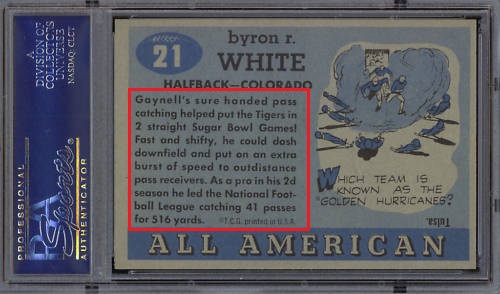
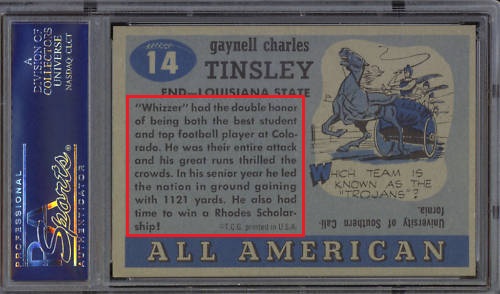
Years ago, when I first read about these errors, I assumed that the backs of the cards were swapped in their entirety. Wrong-back cards are fairly common; you can see a few of them on my 1960 Fleer virtual uncut sheet page. It was only recently that I learned that only the bio sections of the White and Tinsley cards are swapped. This is why the descriptions in the price guides say Gaynell Tinsley (Whizzer White bio) and Whizzer White (Gaynell Tinsley bio). Duh.
I have always thought that the corrected Whizzer White card was undervalued, considering that it is his rookie card, and that he served as a U.S. Supreme Court justice for 31 years after his football career. White’s card sells for only about double the price of a common in the 1955 All-American set, and the price guides put it at two or three times the price of a common. His error card sells for much more, but that is because of its scarcity, not his fame.
For more on the 1955 Topps All-American set, see A is for All-Americans.

